 Jupag
Jupag staking rewards and the JupSOL exchange rate
last updatedJupag offers JupSOL liquid staking, where rewards increase the SOL represented by each token while your token balance stays unchanged. Staking rewards, maximal extractable value (MEV), and priority fees accrue to the pool. You track their effect through the pool exchange rate; a swap price can differ because it also reflects market liquidity.
JupSOL connects SOL staking with a transferable Solana token. Its redemption value, quoted trading price, and dollar valuation describe different things. Fees and the method that you choose for exiting determine how much liquid SOL you actually receive.
Bottom line: JupSOL's pool redemption value can differ from its market price, so the exit method changes your available SOL proceeds.
From a SOL deposit to a completed JupSOL withdrawal
A direct SOL deposit followed by Delayed Unstake follows the pool conversion path from staking value to liquid SOL. The expected holding state is an unchanged JupSOL count with rewards reflected in its SOL redemption value.
| Stage | Action or change in the holding | Required asset, account, or transaction state |
|---|---|---|
| Deposit request | Select a direct SOL deposit for JupSOL. | SOL available in the depositing wallet. |
| Pool deposit | SOL enters the pool, and JupSOL represents the deposit. | Completed deposit transaction. |
| Reward accrual | Pool rewards increase SOL redemption value per JupSOL. | Underlying SOL remains staked. |
| Delayed Unstake | JupSOL converts into a stake account. | Resulting stake meets the pool minimum. |
| Deactivation | The stake account completes deactivation. | Completion of the applicable epoch transition. |
| SOL claim | Request withdrawal from the deactivated stake account. | Stake account ready for withdrawal. |
| Wallet receipt | Completed claim returns liquid SOL. | Successful withdrawal transaction. |
| End state | Liquid SOL has reached the wallet. | Claim transaction completed. |
Continue to the SOL claim only after deactivation completes. A deactivating account requires waiting; the requested liquid-SOL withdrawal is still unfinished. If the app reports that the resulting stake falls below the pool minimum, stop before submitting the JupSOL-to-stake conversion.
Why does the JupSOL balance stay the same?
JupSOL records staking income through a higher SOL redemption value per token, so reward accrual leaves the token count unchanged. If Q is your JupSOL quantity and R is the pool rate in SOL per JupSOL, gross redemption value equals Q × R. For a direct deposit, dividing the SOL amount by R gives the corresponding JupSOL quantity. Direct SOL deposits carry no pool deposit fee. A token count below the deposited SOL amount does not by itself indicate a loss: the quantities use different units.
You do not need a separate reward claim. Transfers and trades change wallet balances independently of that accrual, so a balance comparison must account for tokens that entered or left the wallet.
Multiplying Q by R gives a value in SOL, without converting it into dollars. The dollar valuation also depends on SOL's market price. A growing SOL redemption value can therefore coexist with a falling dollar value when SOL declines.
Reward sources and the charges that reduce accrual
The pool combines Solana inflation rewards with validator revenue from MEV and priority fees. Inflation rewards arrive by epoch. The amount that remains after reward charges contributes to growth in the SOL redemption value represented by JupSOL.
Inflation rewards
Validator commission
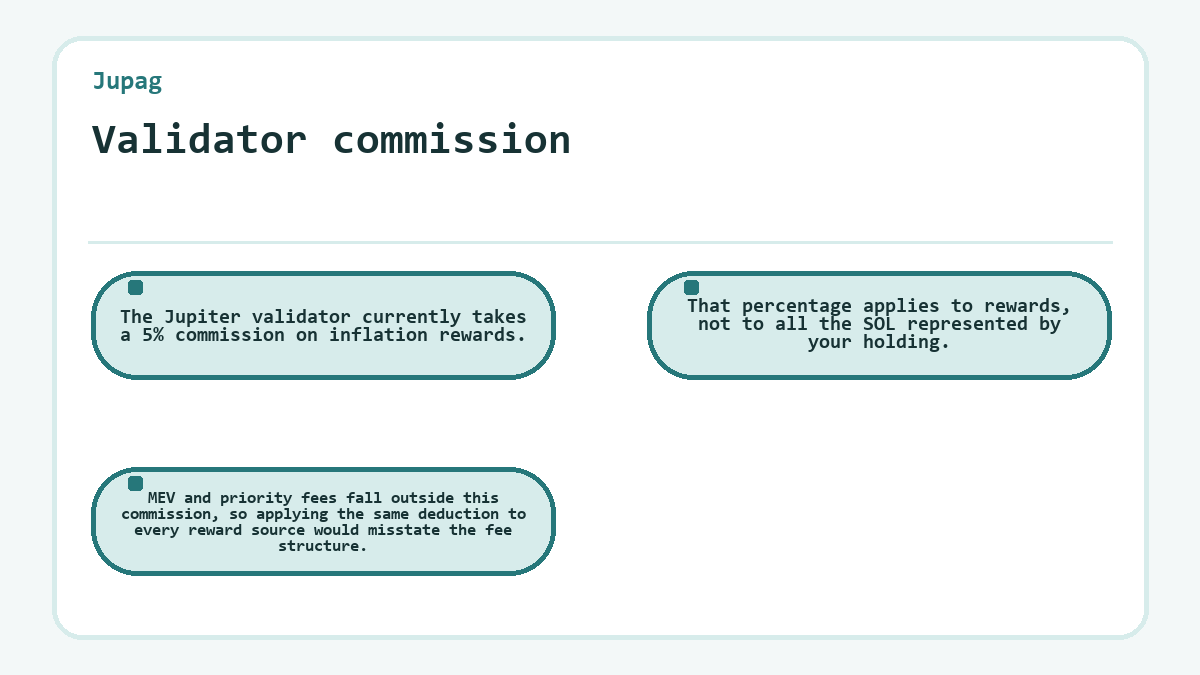
The Jupiter validator currently takes a 5% commission on inflation rewards. That percentage applies to rewards, not to all the SOL represented by your holding. MEV and priority fees fall outside this commission, so applying the same deduction to every reward source would misstate the fee structure.
Sanctum epoch fee
A separate 5% epoch fee applies to base staking rewards under Sanctum's SPL Stake Pool Program. Of those base rewards, 2.5% goes to Sanctum and 2.5% to the Jupiter DAO treasury. This charge is separate from the validator commission. Neither reward charge represents a deduction of that percentage from the entire deposited balance.
MEV and priority fees
MEV rewards come from value captured through transaction ordering. The validator applies no MEV commission, and Sanctum's separate epoch fee also excludes MEV. Priority fees attributable to JupSOL's stake join the pool without either inflation-reward charge. These revenue streams contribute to the exchange rate alongside the net inflation rewards.
Choosing between a pool exit and a market sale
A swap sells JupSOL at the available market price, while a pool withdrawal uses the pool exchange rate and withdrawal conditions. The asset that you receive also matters: liquid SOL, an active stake account, and an account awaiting deactivation have different uses.
Delayed Unstake converts JupSOL into a stake account that must deactivate before you can claim SOL. This process takes approximately one Solana epoch, or about two days. The resulting account must meet the pool's minimum stake. Deactivation follows the epoch schedule, so the remaining wait depends on the account's state.
To Native Stake converts JupSOL into an active stake account delegated to the Jupiter validator. The conversion is immediate within the pool's available instant capacity. The pool's withdrawal fee applies to that conversion. Above that capacity, the interface directs you toward Delayed Unstake. The same resulting-account minimum applies. An active account continues earning staking rewards; liquid SOL requires a later unstaking and withdrawal.
Swapping JupSOL to SOL avoids the delayed-unstaking path, although available liquidity and slippage shape the output. Standard swap fees apply depending on the route. A route that unwraps JupSOL also incurs the pool's withdrawal fee. The quoted market output can therefore differ from the holding's gross pool redemption value.
Which fees reduce JupSOL redemption proceeds?
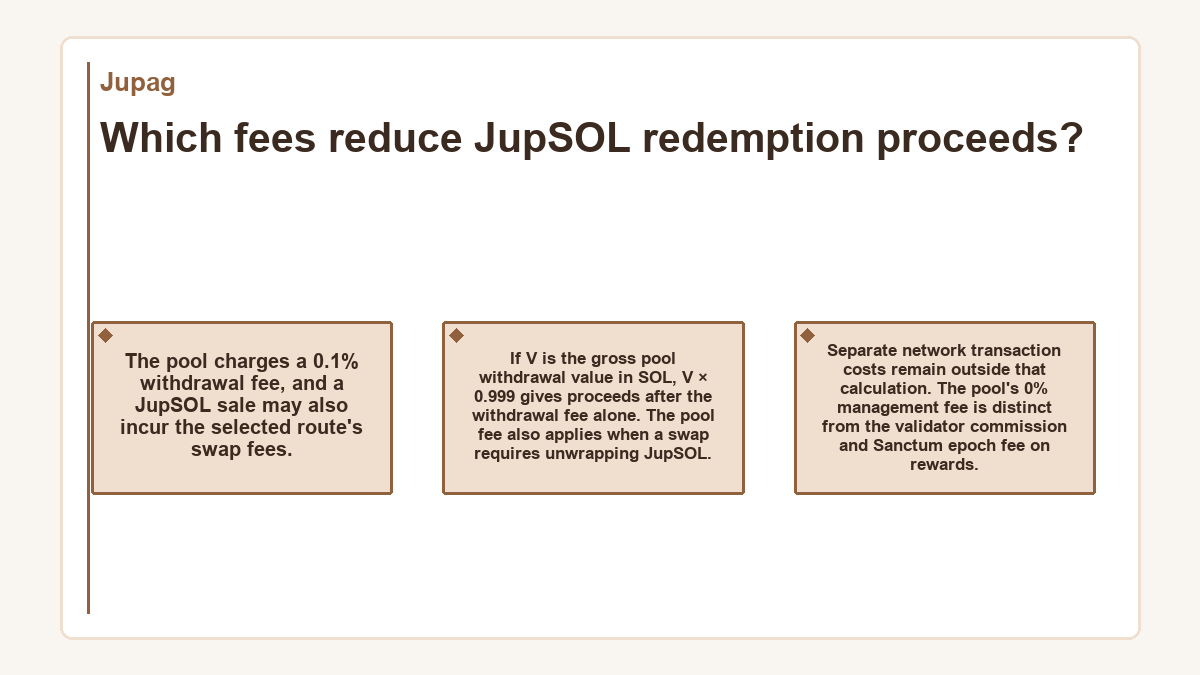
The pool charges a 0.1% withdrawal fee, and a JupSOL sale may also incur the selected route's swap fees. If V is the gross pool withdrawal value in SOL, V × 0.999 gives proceeds after the withdrawal fee alone. The pool fee also applies when a swap requires unwrapping JupSOL. Separate network transaction costs remain outside that calculation. The pool's 0% management fee is distinct from the validator commission and Sanctum epoch fee on rewards.
The market discount and the collateral valuation
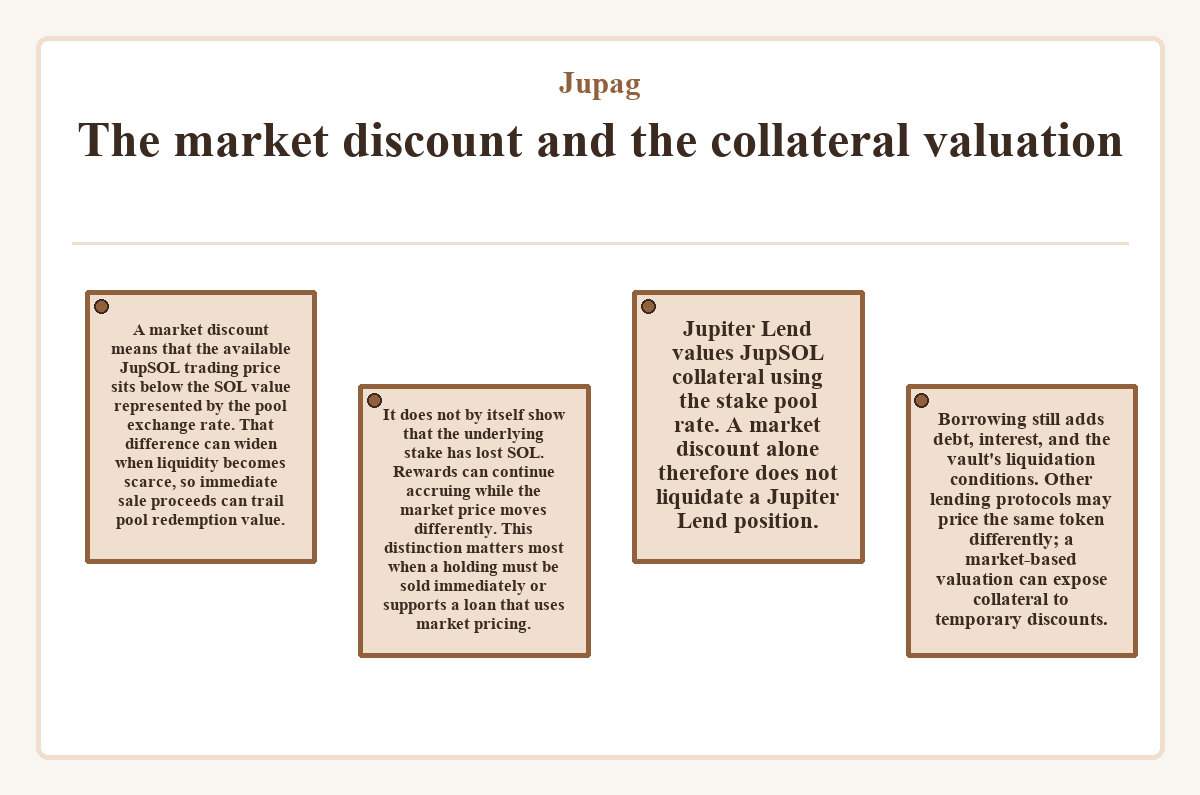
A market discount means that the available JupSOL trading price sits below the SOL value represented by the pool exchange rate. That difference can widen when liquidity becomes scarce, so immediate sale proceeds can trail pool redemption value. It does not by itself show that the underlying stake has lost SOL. Rewards can continue accruing while the market price moves differently. This distinction matters most when a holding must be sold immediately or supports a loan that uses market pricing.
Jupiter Lend values JupSOL collateral using the stake pool rate. A market discount alone therefore does not liquidate a Jupiter Lend position. Borrowing still adds debt, interest, and the vault's liquidation conditions. Other lending protocols may price the same token differently; a market-based valuation can expose collateral to temporary discounts.
Holding JupSOL through changing rewards
An estimated annual percentage yield (APY) annualizes variable rewards; it does not promise the same growth throughout the year. Validator performance and network conditions change the inflows that reach the pool. JupSOL also depends on Sanctum's SPL Stake Pool Program, so program vulnerabilities can affect the underlying staking arrangement. Liquidity can become scarce independently of the pool's reward accrual.
The next choice turns on whether the holding needs to remain transferable, become native stake, or return to liquid SOL. If spendable SOL is the immediate requirement, the relevant comparison is the available swap output against the wait for a pool withdrawal.
Helpful answers about Jupag
Does transferring JupSOL interrupt staking reward accrual?
Transferring JupSOL does not interrupt the pool's staking activity or reset the token's exchange rate. The receiving wallet holds the transferred claim on the pool. Rewards accrue through the SOL redemption value per token. A transfer changes ownership and wallet balances; it does not create a separate reward payment for the sending wallet.
What happens to staking rewards when JupSOL becomes lending collateral?
JupSOL continues accruing staking value when you supply it as collateral on Jupiter Lend. Its exchange rate follows rewards in the stake pool regardless of where the token sits. That accrual does not settle your loan: borrowing interest and repayment obligations remain separate. The vault's collateral valuation and liquidation conditions determine how the combined position behaves.
Which native stake accounts qualify for conversion into JupSOL?
Conversion into JupSOL requires a stake account delegated to a validator in the JupSOL pool. Jupiter Stake can convert eligible accounts in whole or in part without waiting for deactivation. The Manage tab also shows accounts delegated to other validators, although their presence does not establish conversion eligibility. Those accounts support deactivation through that interface.
Are JupSOL rewards the same as Jupiter DAO Active Staking Rewards?
JupSOL staking yield and Jupiter DAO Active Staking Rewards (ASR) belong to different products. JupSOL represents SOL staked through a liquid staking pool. ASR relates to JUP held in Jupiter DAO governance staking, with allocations based on time-weighted stake. Holding JupSOL does not establish a JUP governance stake, and its exchange-rate growth is separate from ASR.
Who manages the SOL staking behind JupSOL?
Sanctum handles JupSOL's day-to-day pool management, including delegating deposited SOL. The Jupiter validator contributes staking rewards, MEV rewards, and priority fees to the pool. The pool's management authority faces caps on fee changes and must provide advance warning before changes take effect. These controls apply to the management role within Sanctum's SPL Stake Pool Program.
Does swapping another token into JupSOL incur the same charges as depositing SOL?
A direct SOL deposit has no pool deposit fee, while a swap into JupSOL follows the fees that apply to its route. The acquisition price may also differ from the pool exchange rate. Use the swap quote to estimate your JupSOL output instead of the pool-deposit calculation alone. The completed swap determines how much JupSOL you receive.