 Jupag
Jupag token swaps, lending, and perpetual futures on Solana
last updatedJupag is the Jupiter platform for routed token swaps, lending, borrowing, and perpetual futures on the Solana network. A spot trade exchanges tokens, a Borrow position creates collateral-backed debt, and a perpetual position adds leveraged exposure. Staking, portfolio tools, and developer APIs extend those functions beyond a single trade.
A shared Jupiter interface connects trading and lending, while each product keeps its own funding model, costs, and position risks.
Token selection and trade size shape the swap quote
The tokens and amount that you select determine which liquidity Jupiter can quote and how much output it offers. Its managed swap path compares eligible engines, including Metis and JupiterZ, to seek better execution prices. Metis accesses onchain liquidity across Solana exchanges; JupiterZ requests quotes from market makers. These different liquidity sources can produce competing quotes for the same requested exchange.
A quote applies to its selected input amount and market conditions. Changing the amount changes the exchange that the routing system needs to price. Expected output describes a quote; the final wallet amount reflects execution and any fee collected in the output token. A favorable quote still needs a valid transaction and successful execution before it represents a completed token exchange.
What separates limit orders from DCA?
Limit orders tie execution to a price condition, while dollar-cost averaging (DCA) divides deposited funds into scheduled swaps. Both use Jupiter routing when an order executes. Time-based DCA follows an interval; price-conditional DCA only fills a scheduled round inside its configured price band.
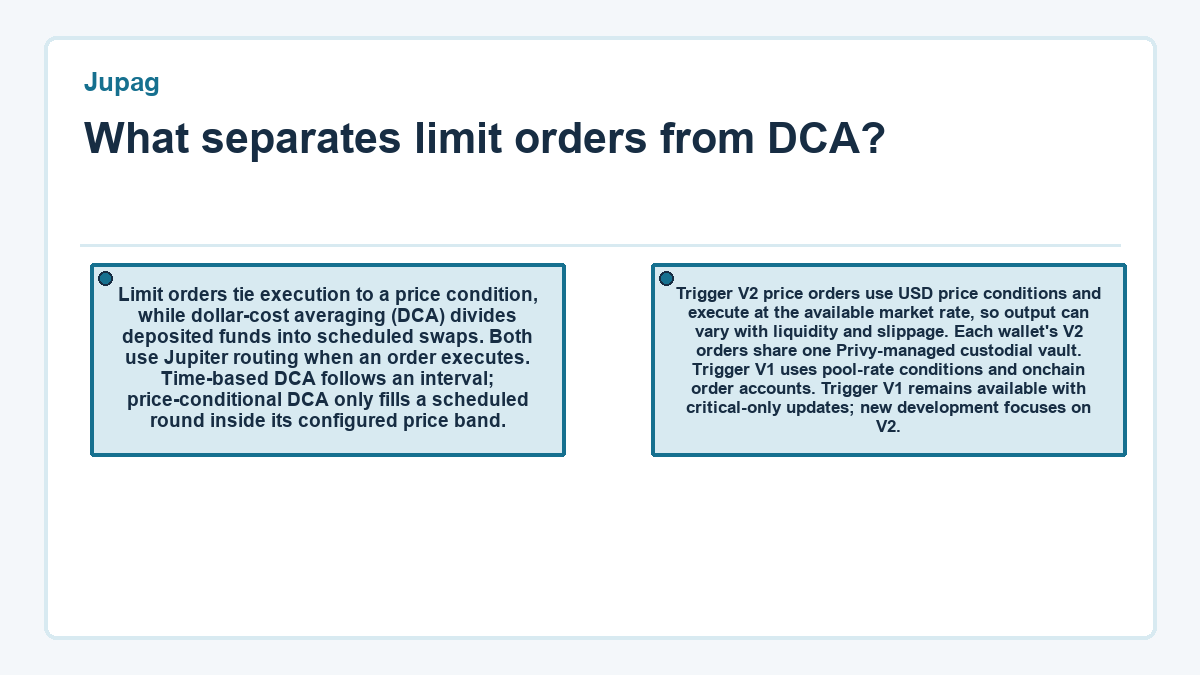
Trigger V2 price orders use USD price conditions and execute at the available market rate, so output can vary with liquidity and slippage. Each wallet's V2 orders share one Privy-managed custodial vault. Trigger V1 uses pool-rate conditions and onchain order accounts. Trigger V1 remains available with critical-only updates; new development focuses on V2.
How does Jupiter Lend connect deposits and loans?
Jupiter Lend connects Earn deposits with collateral-backed Borrow positions through a shared liquidity layer.
Interest from borrowers contributes to depositor yield. Borrowers commit assets as collateral to secure their debt. Collateral options include SOL, liquid staking tokens, the Jupiter Liquidity Provider (JLP) token, tokenized stocks, and Bitcoin-based assets, with debt choices that vary by vault. Loan-to-value (LTV) expresses maximum debt as a percentage of collateral value. Each Jupiter Lend borrowing vault has its own loan-to-value limit. The liquidation threshold is a separate, higher debt-to-collateral ratio that makes a position eligible for liquidation.
At the liquidation threshold, third-party liquidators can repay debt and receive collateral plus a penalty. Normal liquidations are partial, and the penalty applies to the liquidated portion. If the ratio exceeds the vault's Liquidation Max Limit, full liquidation can occur. Liquidators may act after the threshold crossing, leaving the position at risk in the meantime. Smart contract vulnerabilities also threaten deposited assets.
Borrowing costs primarily reflect the variable interest rate on the debt. Where collateral also earns yield, Net APY (net annual percentage yield) combines that interest with borrowing costs, using collateral value minus debt value as its base. Multiply increases exposure by borrowing against collateral and converting the borrowed asset back into collateral. Price movements and the difference between earned yield and borrowing costs then affect the leveraged position's return.
Perpetual futures and prediction markets track different exposures
Jupiter Perps supports leveraged long and short positions, with collateral backing exposure that can exceed the funds committed. Its SOL, ETH, and wBTC markets borrow from the JLP pool and charge borrow fees; separate GUM-powered Beta markets use USDC collateral and hourly funding instead of borrow fees. Adverse price moves can lead to liquidation. Prediction markets concern outcomes of real-world events, using binary contracts. A perpetual position follows asset-price exposure, while an event contract depends on its specified outcome.
Staking and portfolio tools extend the same interface
SOL staking connects funds to validator rewards, and Jupiter provides native and liquid staking options alongside its trading products. JupSOL provides the liquid staking route, representing staked SOL through a transferable token. Staking rewards come from a different mechanism than lending interest. JUP staking locks JUP in a governance contract to provide voting power, with a seven-day unstaking cooldown.
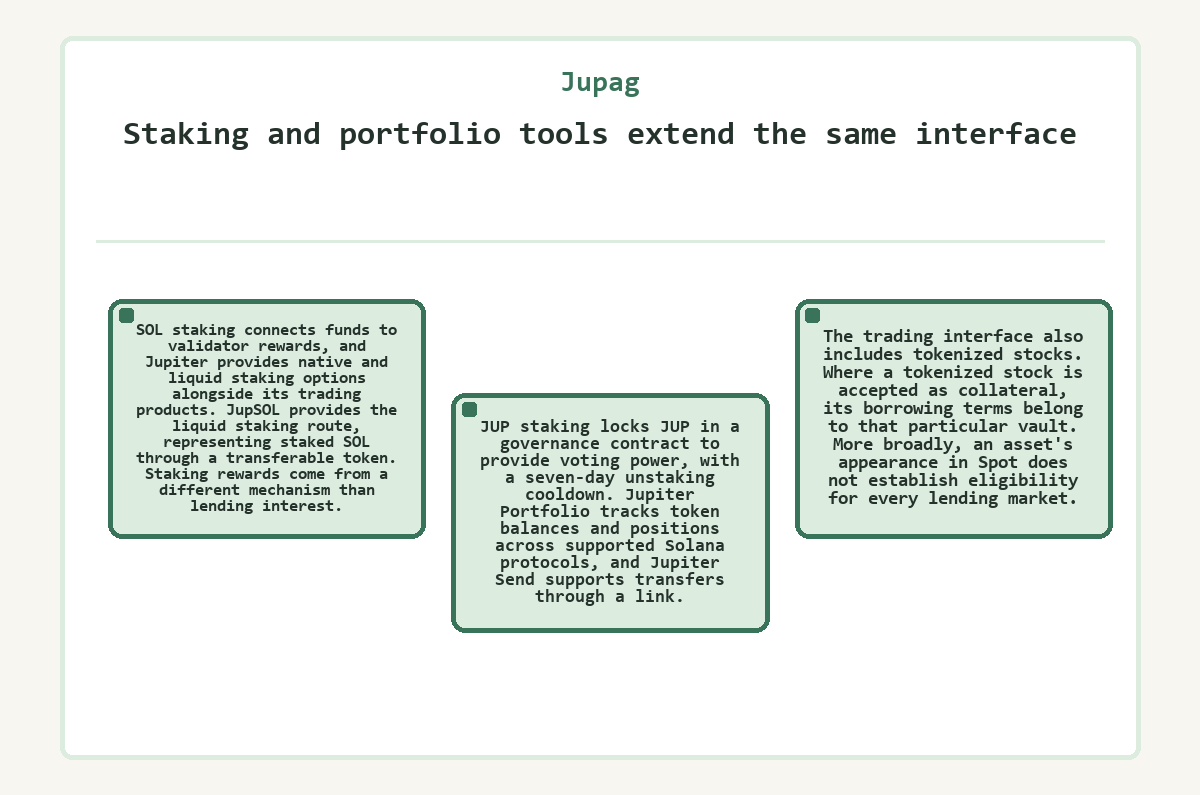
Jupiter Portfolio tracks token balances and positions across supported Solana protocols, and Jupiter Send supports transfers through a link. The trading interface also includes tokenized stocks. Where a tokenized stock is accepted as collateral, its borrowing terms belong to that particular vault. More broadly, an asset's appearance in Spot does not establish eligibility for every lending market.
How do Jupiter's apps and developer tools connect?
Jupiter's apps provide trading and asset-management interfaces, while its APIs expose related capabilities to software integrations. The browser interface connects a compatible wallet for wallet-based actions. Jupiter Mobile and the Jupiter Wallet extension provide additional access choices.
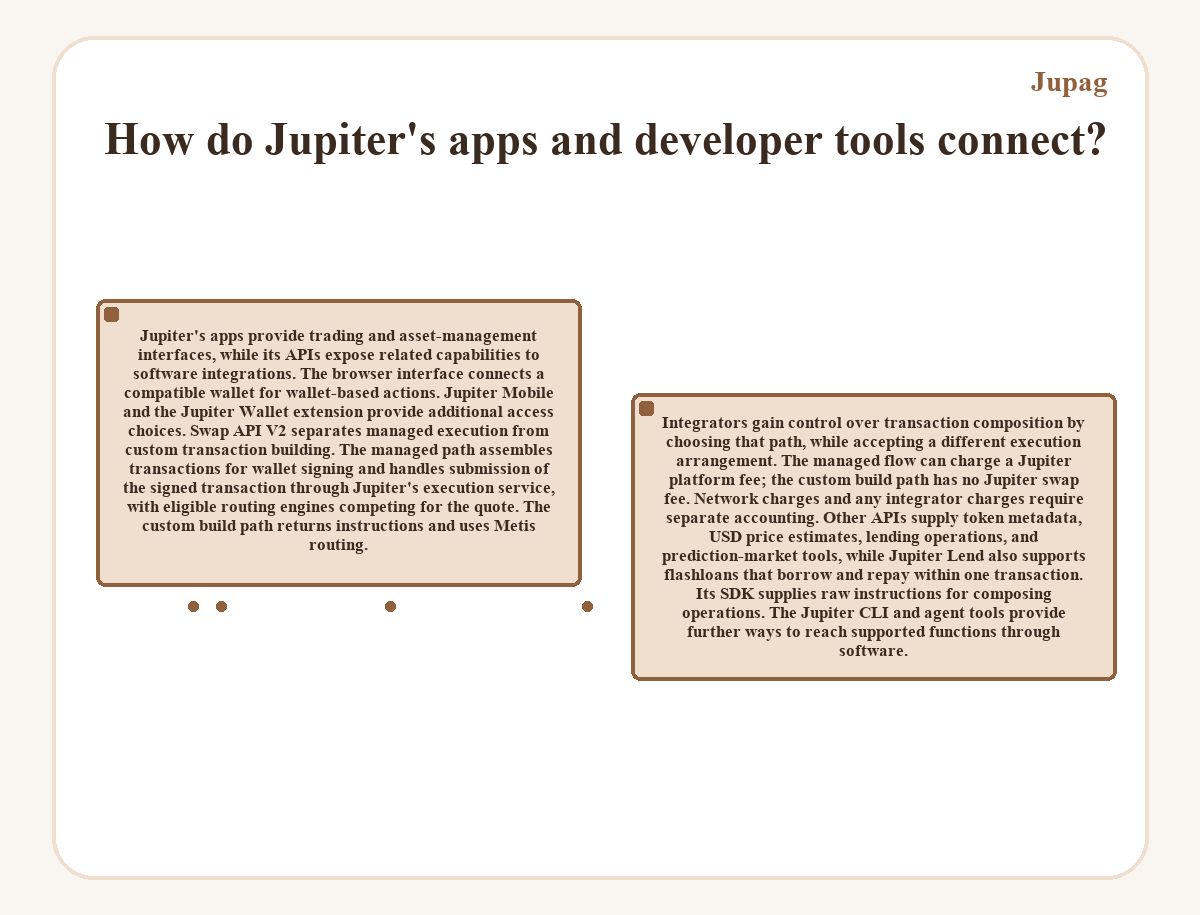
Swap API V2 separates managed execution from custom transaction building. The managed path assembles transactions for wallet signing and handles submission of the signed transaction through Jupiter's execution service, with eligible routing engines competing for the quote. The custom build path returns instructions and uses Metis routing. Integrators gain control over transaction composition by choosing that path, while accepting a different execution arrangement.
The managed flow can charge a Jupiter platform fee; the custom build path has no Jupiter swap fee.
Network charges and any integrator charges require separate accounting. Other APIs supply token metadata, USD price estimates, lending operations, and prediction-market tools, while Jupiter Lend also supports flashloans that borrow and repay within one transaction. Its SDK supplies raw instructions for composing operations. The Jupiter CLI and agent tools provide further ways to reach supported functions through software.
Match each product to your trading or borrowing goal
- For a different token balance, Spot applies routing to the chosen pair and amount; compare the quoted output and applicable charges.
- For price-dependent execution, a limit order uses its version's trigger rules and funding accounts; Trigger V2 does not fix the final output amount.
- For recurring purchases, time-based DCA follows a schedule; price-conditional DCA also requires each round's price to fall inside the configured band.
- For a collateral-backed loan, the selected vault determines the collateral-debt pair, borrowing limit, and liquidation threshold that apply to the position.
- For leveraged exposure, Perps and Multiply add position obligations that a simple spot balance does not carry; adverse movements can consume collateral.
Borrowing leaves an outstanding debt after funds become available. Repaying debt or adding collateral lowers the debt-to-collateral ratio, changing how close that position sits to liquidation.
Common questions, answered
Why does the Jupiter trading interface show a JavaScript warning?
Jupiter's web trading interface requires JavaScript to run. When JavaScript is disabled, the page displays a warning asking for it to be enabled or for a supported browser. Changing the token pair or order amount does not address that browser requirement.
Does a Jupiter API integration require a paid plan?
A Jupiter integration can use a free API key, so a paid plan is not required for basic access. Paid tiers increase permitted request rates and included usage credits. API plan charges belong to application access; they do not replace trading charges or borrowing interest. The suitable plan depends on the application's request volume and required platform features.
What does a verified token label establish?
A verified label means that a token has passed Jupiter's verification process. The process considers trading activity, social presence, and community review; it does not promise a future price or remove liquidity risk. Unverified status can mean that a token has not been reviewed or has not met the criteria.
Why can borrowing stop below a vault's LTV limit?
A Jupiter Lend vault can reach its borrowing ceiling even when a particular position remains below its LTV limit. Borrowing also depends on the debt asset's maximum permitted market utilization. Either limit can leave less capacity than the collateral ratio suggests. The displayed remaining borrowable amount describes that availability, separately from the position's liquidation threshold.
Does the Jupiter wallet remove every swap cost?
Jupiter's claim about no additional wallet fees concerns a wallet surcharge, not every cost of a trade. Platform and network costs still follow the selected swap path and funding arrangement. A managed Swap API V2 quote can include a platform fee, and its total fee rate can also include gasless cost recovery.
Where can recipients claim tokens sent through Jupiter Send?
Recipients claim Jupiter Send tokens through Jupiter Mobile. The sending tools can create an invite for someone who does not already have a connected wallet, and the invite may arrive as a link or QR code. The Send API supports send creation, invite management, and clawback transactions.